
In the woods that border two ballfields in Flint Park, there is a creek most locals don’t know exists. It appears out of nowhere, popping out from a culvert under Boston Post Road beside a car dealership a few hundred yards from Save the Sound’s Larchmont office. It turns left into the park and remains unveiled if unnoticed before disappearing back underground just before the main parking lot at the middle school. From there, it turns right, slicing invisibly past the Town pool, an ice rink, a turf field on one side and grass playing fields on the other, before emptying into a salt marsh in the Hommocks Conservation Area.
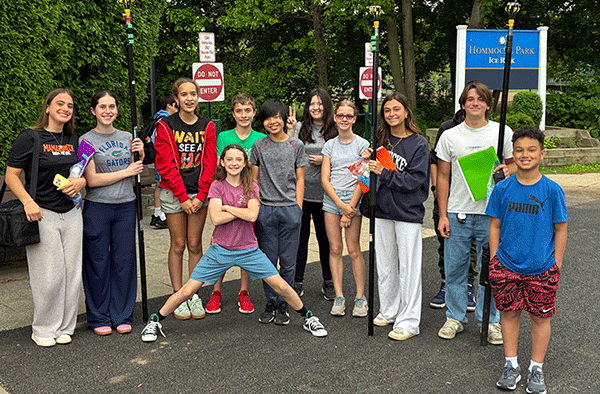
This spring, four students from Mamaroneck High School’s Original Civic Research and Action program not only noticed East Creek, they focused on it. They created an after-school program in which they would lead a group of seventh-graders in a four-week water quality monitoring program—and to “help protect our local ecosystem,” as this opportunity was presented in a flyer to recruit students.
“My sister came up with the idea for the project,” said Gabe Pazona, who along with his sister, Olivia, Ella Golden, and Alex Gill, were trained and equipped by Save the Sound to collect samples twice-a-week after school at three locations along the creek. “We were doing some research on crucial ecosystems in the area and found the salt marsh right next to Hommocks. We thought it would be good for students to learn about conservation and why it’s important for the community.”
The students followed the same protocols used in our annual bacteria monitoring program in the western Sound, currently in its 12th season. They dipped sample bottles, affixed to the ends of extendable poles, into the creek, scooping up 100 milliliters of water. The samples were returned to our John and Daria Barry Foundation Water Quality Lab, where they were processed to determine the amount of fecal indicator bacteria present. Samples that meet state-established safe-swimming criteria are considered to have passed; 23 of the 24 samples collected failed to meet those standards, several by more than 10 times the limit.
“When you see numbers and can put a specific value to it, water quality becomes a less abstract concept,” said Lindsey Potts, our lab technician who processed the students’ samples. “Maybe this will help them grow more curious about it, maybe even something they become passionate about. It’s important to help the public, including young people, get engaged and be aware of how to understand then protect water quality in their community.”
As with all of Save the Sound’s monitoring programs, data isn’t an end result. It’s the starting point for finding a solution to a local pollution problem.
“For these students, the Conservation Area is really an outdoor classroom,” said Joe Liberti, a teacher at Mamaroneck High School and coordinator of the OCRA program. “This collaboration has helped the students understand that they have a role as community scientists, and it’s not a passive role. The water sampling they’re doing provides necessary data that can become actionable.”