As they reached the bridge that marked the end of a thousand-meter piece, Reagan Amundsen and her three Maritime Rowing Club teammates in the shell stopped to catch their breath. What she noticed that morning in that particular stretch of the Norwalk River, though, took her breath away.
There was debris floating in the water, an oil sheen along the top, and a hint of sewage.
“When we took the boat out of the water to clean it after our row, there was a bunch of stuff on the side of our boat,” said Reagan. “That stuck with me.”
Someone, she remembers thinking, has to do something.
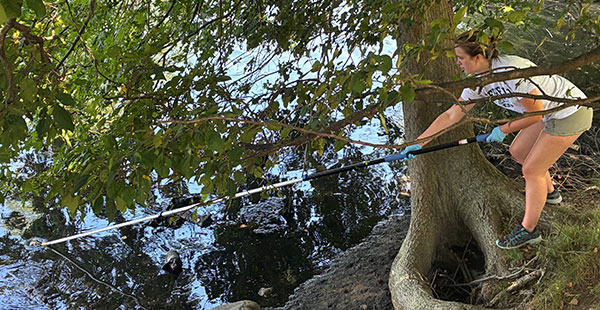
For the last several summers, Reagan, then a high school sophomore, now a rising senior, has done her part to help Save the Sound better understand the water quality challenges in the western Long Island Sound. She and her father, Stein, volunteer to collect water samples as part of our 12-week bacteria monitoring program. Reagan estimates they’ve sampled most of the locations in Greenwich and along the Sound Shore of Westchester County. This season, they’ve covered multiple sites, including two in Rye along Blind Brook—a section beside Disbrow Park, where the wastewater treatment plant is located, another just inside Rye Nature Center—and one at Playland Lake in the Edith G. Read Natural Park and Wildlife Sanctuary.
Whenever possible, she also assists a team from the Town of Darien during their outings into Scott Cove, Darien Harbor, and Cove Harbor for the Unified Water Study, making her one of the few community scientists in the region who have participated in both of Save the Sound’s primary water quality monitoring programs. Reagan uses a multi-parameter sonde (a device for testing physical conditions) to help collect readings of water conditions such as dissolved oxygen and temperature, providing data that gets incorporated into our biennial Long Island Sound Report Card (the next one will be released in 2026).
Sure, those 5:00 a.m. wakeups can be a tough call for anyone to answer, let alone a high school student getting ready for the college application process. But being out on the water just after dawn, seeing osprey nests and an occasional eagle, is worth it—as is knowing that she’s helping create awareness of water quality.
“It’s very important,” said Reagan, hoping more of her peers will start paying more attention. “We are the next generation. We’re up. This is our world to help take care of.”