Not so very long ago, the numbers were bleak.
The 2022 spring fish run in Connecticut was down about 350,000 alewife. Blueback herring fared even worse—only 570 bluebacks were counted by state-monitored runs, a decrease of 99.9 percent from 1985. Both species of river herring are critical to the food web, in Connecticut’s rivers and out in the open waters of Long Island Sound and the Atlantic Ocean, and four years ago, they were on the brink of becoming extirpated in our region.
Restrictions on recreational fishing and hundreds of billions of dollars spent improving water quality and hundreds of millions on removing dams to increase passage did not seem to be turning things around for fish that have been a keystone species in Connecticut since the pre-colonial days.
Thanks to increasingly proactive fishery management, long-awaited maps, and a little overdue good fortune, river herring populations enter the summer of 2026 on a trajectory toward recovery. River herring populations rebounded 39 percent in 2024, 36 percent in 2025. Final numbers for this year’s fish run have not yet been released, but it appears to be a third good run in a row.
“The state is still counting, but it’s looking like this year could be as good if not better than last year,” said Bill Lucey, our Long Island Soundkeeper. “This corroborates what we’re seeing in the federal State of the Ecosystem Report, which not just for Long Island Sound but the whole New England seaboard. The federal survey boat, the Bigelow, had the most blueback herring captured in recent times.”
The turnaround was initiated by lower fishing effort from fleets known to intercept river herring at sea. Before the anadromous fish could return to their native spawning grounds in the rivers that feed into the Sound, hundreds of thousands of river herring wound up as bycatch, incidental casualties swept up primarily by the midwater trawl fleet while they fished for mackerel and Atlantic herring. Genetic data obtained from historic bycatch confirmed that nearly 60 percent of river herring bycatch in New England were runs originating in the rivers of Long Island Sound and Block Island Sound.
Overfishing of both mackerel and Atlantic herring resulted in closure of the mackerel fishery and highly reduced quotas for the Atlantic herring fishery. This led to a lower fishing effort, hence lower bycatch. To be clear, these fisheries do not target river herring and prefer to avoid them as harvest catch caps are in place for river herring. If too many end up as bycatch, sections of the ocean are shut down for Atlantic herring and mackerel.
“The three-year closure of the mackerel fishery and highly reduced quotas on Atlantic herring drastically dropped the at-sea effort, allowing blueback herring and alewives to get a foothold again in our region,” said Bill. “It’s amazing to see.”
As a result, more mature fish have been free to return to Connecticut rivers, particularly among alewives at least three years old. The runs are longer in duration, and fish are showing up in habitat they have not used in years. The increasing number of dam removals and fish ladders also continuously extend available habitat farther up the rivers.
“We’re starting to get a healthy proportion of young, middle-age, and old fish back into our fish runs, which will increase genetic diversity and overall resilience,” said Bill.
Then there are the maps. At the Herring Committee meeting earlier this month, Bill and other members of the committee got to see what they’ve been waiting for: “Species Distribution Models to inform River Herring & Shad Bycatch Closures.” This model, informed by independent fishery surveys and observed catch rather than an arbitrary percentage of past harvests and water quality data (such as surface and bottom temperatures, salinity, depth, etc.), shows how many of a certain species would be present at a particular location in a given month.
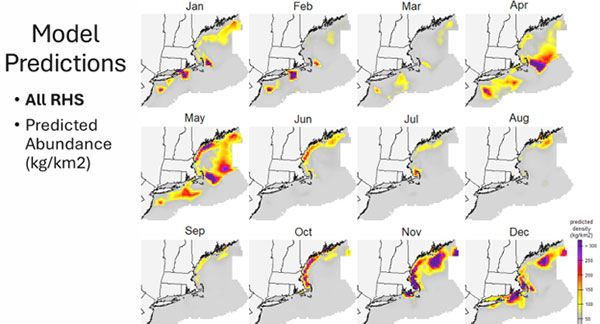
“You could look at this and see that the model says if you drop a tow here in this place at this time of year, you’re probably going to run into alewife at this magnitude,” said Bill. “This is exactly the kind of data we’ve wanted.”
This survey can now be used to inform Council decisions moving forward to protect river herring and also the fishing fleet. Those policies could include biologically based catch caps, time-area closures, the reinstitution of electronic monitoring of catches at sea as well as portside sampling by federal monitors.
And there’s even more good news . . . the NEFMC executive director has already announced that the Council’s work on river herring will continue through 2027 if alternative closure options cannot be decided by December. No vote on whether to include river herring on the Council’s priorities list for next year needs to be taken.
Finally, there is momentum toward restoring Long Island Sound river herring. “These fish have been feeding us since the start of the colonial period. For the native people, that privilege extends back thousands of years. Runs river herring and shad were often the first big feasts after a long cold winter for people and wildlife alike, such as the bald eagle. This feast has been denied for over two decades now due to low abundance and overharvesting,” said Bill. “I hope to see commercial and personal-use river herring fisheries existing again in Southern New England. If the runs are allowed to recover to their production potential it will allow all of us and the greater ecosystem our seats at the banquet table.”