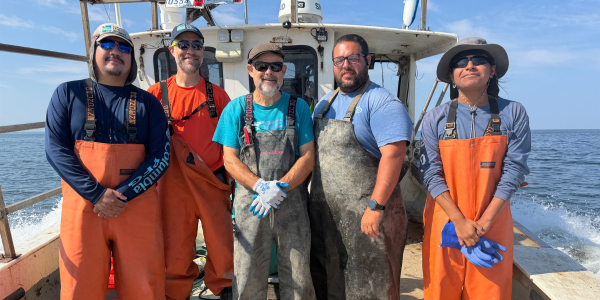
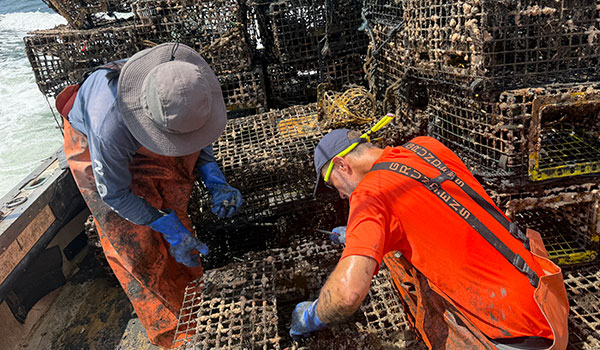
On the last Friday of July, our Soundkeeper team embarked on their 100th trip to remove lost or abandoned lobster traps from Long Island Sound. It’s an important and impressive milestone for this program, launched in 2022 to help save wildlife and retrieve debris that in some cases has been littering the Sound for decades.
In those hundred trips, our team has recovered 2,362 traps. Most were still catching marine life—a problem called “ghost fishing”— including a wide variety of fish, crabs, conches, and even the occasional lobster. The most common species have been tautog, black sea bass, and oyster toadfish, while porgy is occasionally found during summer and Atlantic cod in winter.
“When these animals die inside the trap, they attract more animals,” said Nico Acuna Perales, our fisheries technician, who has worked 88 of the trips.
After staff document the bycatch in detail, they set any live animals free and bring the empty traps back to shore. Our team then identifies the trap owners through the affixed ID tag; if the owners don’t want the traps, we recycle them.
The year-round project continues to thrive with the partnership of The Maritime Aquarium of Norwalk, Project Oceanology, and Dr. David Hudson of Remote Ecologist in Connecticut, while Cornell Cooperative Extension of Suffolk County covers the New York side of the Sound.
The lobster industry is a key part of the recovery effort, too. The traps belong to former lobstermen, some who have passed away or left the industry and were unable to retrieve all their traps.
Save the Sound works closely with these local fishermen, whose familiarity with the waters help identify hotspots for the traps, and whose boats are equipped to haul strings of the traps, which can weigh up to 30 pounds (that’s nearly a ton and a half of ghost traps removed from the Sound!).
As for the milestone, Nico said, “I know it’s special, but it’s just one small portion of the rest of the work that we can still do. This is a very important program for Save the Sound, and we’re all proud of the work we’re doing.”