When the calendar flipped to September, the countdown clock for closing the jails on Rikers Island ticked inside two years. That Aug. 31, 2027 legally mandated deadline grows closer every day, yet we are no closer to New York City being ready to meet it Which means we’re not ready to begin converting the island into a hub for renewable energy and the site of a state-of-the-art Wastewater Resource Recovery Facility (WRRF) either.
According to NYC Local Law 16, any portion of Rikers Island not being used to house or provide services to the incarcerated population must be transferred to the Department of Citywide Administrative Services every six months (on Jan. 1 and July 1). No transfer has occurred since Mayor Adams took office in January 2022. The construction of the borough-based jails where prisoners will be transferred once Rikers is closed is behind schedule. The facility in Brooklyn is expected to be ready in 2029, the ones in the Bronx and Queens in 2031, and the one in Manhattan in 2032.
Delays have consequences, and the water quality in the Western Narrows of Long Island Sound simply can’t afford to wait.
“The challenges facing the western reach of Long Island Sound are happening right now,” said Peter Linderoth, our director of healthy waters and lands.
In our 2024 Long Island Sound Report Card, 98% of the open Sound earned a B grade or better for water quality. The remaining 2%—the Western Narrows, which includes the upper East River where Rikers Island is situated—got an F. That section of the Sound has never received a passing grade, dating back to 2008, our first year of available data.
And yet the feasibility study issued a year-and-a-half ago by the NYC Department of Environmental Protection projected that “DEP could start construction of a new WRRF on Rikers Island in 2035 with startup in 2045 and full implementation completed over a 40 year period.”
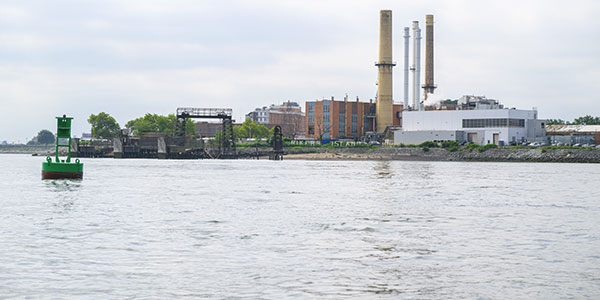
That timeline may be realistic for a project of this magnitude, but that’s a long way into the future. Meanwhile, water temperatures continue to rise, excess nitrogen from combined sewer overflows, wastewater treatment plant effluent, and stormwater runoff goes on polluting the most vulnerable section of the Sound, and the four old WRRFs that surround Rikers Island—Hunts Point in the Bronx, Wards Island in Manhattan, Tallman Island and Bowery Bay in Queens—keep getting older (the latter three will all celebrate their 90th birthdays before 2030.)
As DEP’s 2024 study acknowledges: “A new WRRF on Rikers Island is a feasible long-term strategy for DEP’s treatment system in the upper East River, offering a multitude of benefits that are not possible at the existing WRRF’s.”
Save the Sound will continue to push NYC leadership to adhere to their legal obligation to close Rikers Island and to initiate planning for the beneficial use of the island in the future. Creating a Renewable Rikers Island represents perhaps the most significant steps that could be taken to restore water quality in the Western Narrows.
“We urge the City and the State to expedite this timeline as responsibly as possible, so that we can meet the challenges of today, which are likely to worsen the later we act,” said Peter.
We can’t wait.