2025 Bacteria Monitoring Stats
66 sites, 745 water samples,
16 trained volunteers
2025 Bacteria Sampling Data
Weekly Monitoring Data Maps
Westchester, NY & Greenwich, CT pdf xls
Queens & Nassau Counties pdf xls
Summary by Site pdf xls
Quality Assurance Project Plan pdf
Map Legend
Quick Links
Select Year: 2025 • 2024 • 2023 • 2022 • 2021 • 2020 • 2019 • 2018 • 2017 • 2016 • 2015 • 2014
Fecal Bacteria Monitoring
In 2025, Save the Sound collected and tested water quality at 66 locations from Greenwich, CT, through Westchester County, to Queens, and into Nassau County. Samples were analyzed for fecal indicator bacteria Enterococcus in marine water and E. coli in freshwater, which are used to determine whether waters are safe for swimming. Click on each site on the map above to see what we found. The colors reflect average bacteria levels at each site over the 12-week monitoring season. The “% Pass” and “% Fail” show how many samples passed or failed the single sample criteria for safe swimming in New York and Connecticut.
Our staff and volunteers collected and processed 745 samples, the second-most in the program’s 12-year history; it was the fourth season in a row to analyze more than 700 samples.
State Criteria for Safe Swimming
Samples greater than 104 CFU/100 mL Enterococcus are considered unsafe for swimming in marine water. Samples greater than 235 CFU/100 mL E. coli are considered unsafe for swimming in fresh water.
A weighted average (geometric mean) greater than 35 CFU/100 mL Enterococcus is considered unsafe for swimming in marine water and greater than 126 CFU/100 mL E. coli is considered unsafe for swimming in fresh water.
Summary of Findings: 2025 Season
High Bacteria Counts Persist in Dry Monitoring Season
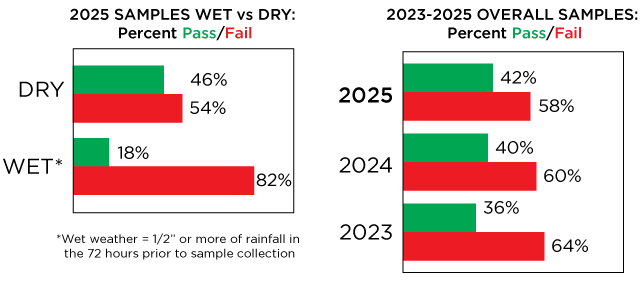
Overall fecal indicator bacteria sample fails decreased for the second straight season, from 60% in 2024 to 58% in 2025. This represents a 6% improvement from 2023 (64% failure rate).
But the real story isn’t the rate; it’s the reason why.
The 2025 season was the driest of the last few years. Only 123 of the 745 samples (16.5%) were taken under wet weather conditions, which occur when a half-inch or more of rainfall is recorded in the 72 hours prior to sample collection. That’s down from 195 wet samples in 2024 (26.4%) and 360 in 2023 (46.3%). The recent year most comparable to this season was 2022, when only 112 wet samples (15.7%) were collected.
Because wet weather causes pollution to flush off the landscape and into the waterways, and can trigger larger volumes of untreated sewage being released, Save the Sound reports on wet and dry weather samples separately. This year, as in all past years, fecal contamination was higher after rainfall at most locations.
Dry Weather Fail Rates Fall, Wet Weather Rates Jump
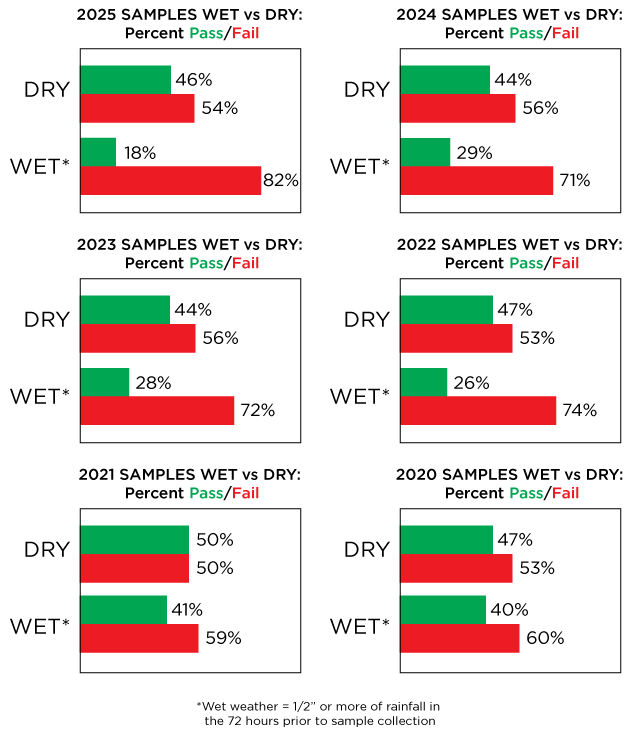
Dry weather samples tend to pass at a higher rate than wet weather samples, and 2025 clearly reflected this disparity. Of the 622 dry samples collected this year—the most we’ve ever collected in a monitoring season—46% passed. That’s a 2% increase over the previous two seasons (both 2023 and 2024 saw 44% of samples pass) and, again, is comparable to 2022 (47%).
While an uptick in passing samples is encouraging, it’s important to recognize that five of the last six seasons have seen more than half of dry samples fail. The last year in which more than 60% of dry samples passed was 2017 (61%).
That 2025 saw only a marginal improvement in overall failure rate can be attributed to a double-digit increase in wet weather fails. This season saw the highest wet weather failure rate (82%) in the 12-year history of Save the Sound’s program, 11% more than in 2024 and 2% above the previous failure rate (80% in 2019). There may have been fewer wet samples collected this year, but those samples tended to have high hits for fecal contamination.
River Show Slight Improvement, Still Most Troubled Sampling Sites
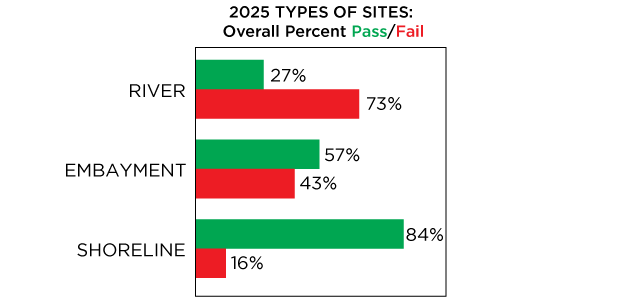
Rivers remained the most polluted sites sampled in 2025, though the failure rate (73%) dropped by 4% from 2024 (77%) and is the lowest since 2021 (70%).
Scientific findings have shown that degraded and leaky sanitary sewer lines can cause fecal contamination in waterways in developed areas during dry weather. Sewer lines are engineered to run from higher-elevation locations to lower ones wherever possible, using gravity to move wastewater to treatment plants, and these pipes often run alongside or close to rivers and streams. Untreated sewage can ooze out of cracked or broken pipes and make its way into those nearby waterways, such as the rivers samples by Save the Sound.
Many of these rivers running through our communities are carrying an unacceptable level of fecal contamination which poses a risk to human health.
Failure rates at shoreline sites (16%) were the lowest since 2022 (16%). Embayments were the only sites that failed more often in 2025 (43%) than the year before (41%).
Best and Worst of 2025
In 2025, there were three locations that had no failing samples. Thirteen produced failing samples for all 12 weeks this year: 10 in Westchester County, one each in Greenwich, Queens, and Nassau County.


Be a Part of the Solution
As long as rivers, streams, and our coastline are polluted, Save the Sound remains committed to restoring water quality where people swim, fish, and paddle.
- Everyone can help reduce sewage pollution simply by conserving water, which will lessen the wear and tear on our water infrastructure and reduce sewage overflows by lowering the volume of water in the system.
- Homeowners and business owners must repair the sewer lines that connect their properties to municipal sewers or maintain their septic systems.
- Dog owners should dispose of pet waste in the trash, never in a catch basin or on the street.
- Save the Sound encourages all members of the public to be on the lookout for water pollution. If you see sewage overflowing in your community, please report anything you see to your local health authorities and to Save the Sound. Let us know by sending a photograph or video plus the time and location of the overflow to pollution@savethesound.org.